Proposal Land

Better RFP Responses & Management
 
Proposal Land

Term: Fairness Monitor

An independent observer of the client’s evaluation process; used in some Canadian government contracting. Responsible for identifying any infractions of the evaluation methodology specified in the RFP.

Usually under contract to Public Services and Procurement Canada (previously PWGSC).

Advice to Procurement Professionals: Be clear

It’s a simple question: Do you want bidders to respond to every line item of your statement of work and/or draft contract in their technical proposals?

Yes, Please

If you do, then say so somewhere in the Instructions to Bidders, maybe like this:

Bidders shall respond to every SOW and/or draft contract line item somewhere in their technical proposal. We recommend cross-referencing these line items against the response instructions (and submitting said cross-reference with the Table of Contents) so that topics are addressed where they make sense, so that nothing is missed, and so that evaluators can quickly look up responses to specific SOW and draft contract line items.

You might even give them a cross-reference table to be completed with the appropriate proposal references, just so that everyone does the same thing.

Good God, No!

If you don’t want to see responses at this level of granularity – if, instead, you want to see high-level management or operational plans and examples of relevant experience that demonstrate bidders’ ability to do similar work – then say so, maybe like this:

Bidders shall provide the responses specified in the Instructions to Bidders.  For greater clarity, bidders shall NOT respond to every SOW and draft contract line item.

Whether it’s Yes or No, Be Precise

Don’t give hand-waving instructions like this:

Bidders shall follow RFP numbering exactly in their responses and responses shall be complete.

For bidders, the RFP is the whole thing: the actual RFP and all its attachments, including the SOW and draft contract.  So some folks on the proposal team are always sure that this sort of vague instruction is code for “Address every line item of the whole RFP somewhere in your proposal.”  If what you mean is that the response should be numbered in accordance with the RFP’s Instructions to Bidders (a perfectly reasonable requirement but one that should actually go without saying), then say just that:

Bidders shall number their responses in accordance with the numbering in the Instructions to Bidders.


Don’t say this either:

Show how your solution addresses SOW requirements.

For bidders, the obvious and safest response to such a requirement is to address every SOW line item in painstaking (and painful) detail.  If what you mean is that the response should show how some specific objective or deliverable is satisfied, then specify a meaningful objective or deliverable for every section of the response.

 

Term: Evaluation Criteria

How the client will mark the proposals.

What they are

  • Usually include weights of sections, so you know what matters
  • Sometimes identify minimum thresholds or scores that bidders must meet to be considered technically compliant
  • Can include mandatory requirements in addition to rated criteria
  • Can specify content or standards for the proposal

What they are not

They are not as detailed or as clear as you’d like. Never.

What not to do with them

Don’t confuse them with response instructions or a table of contents for the proposal (that is, don’t use them to organize or structure the response unless they are explicitly provided for that purpose).

Show, Don’t Tell

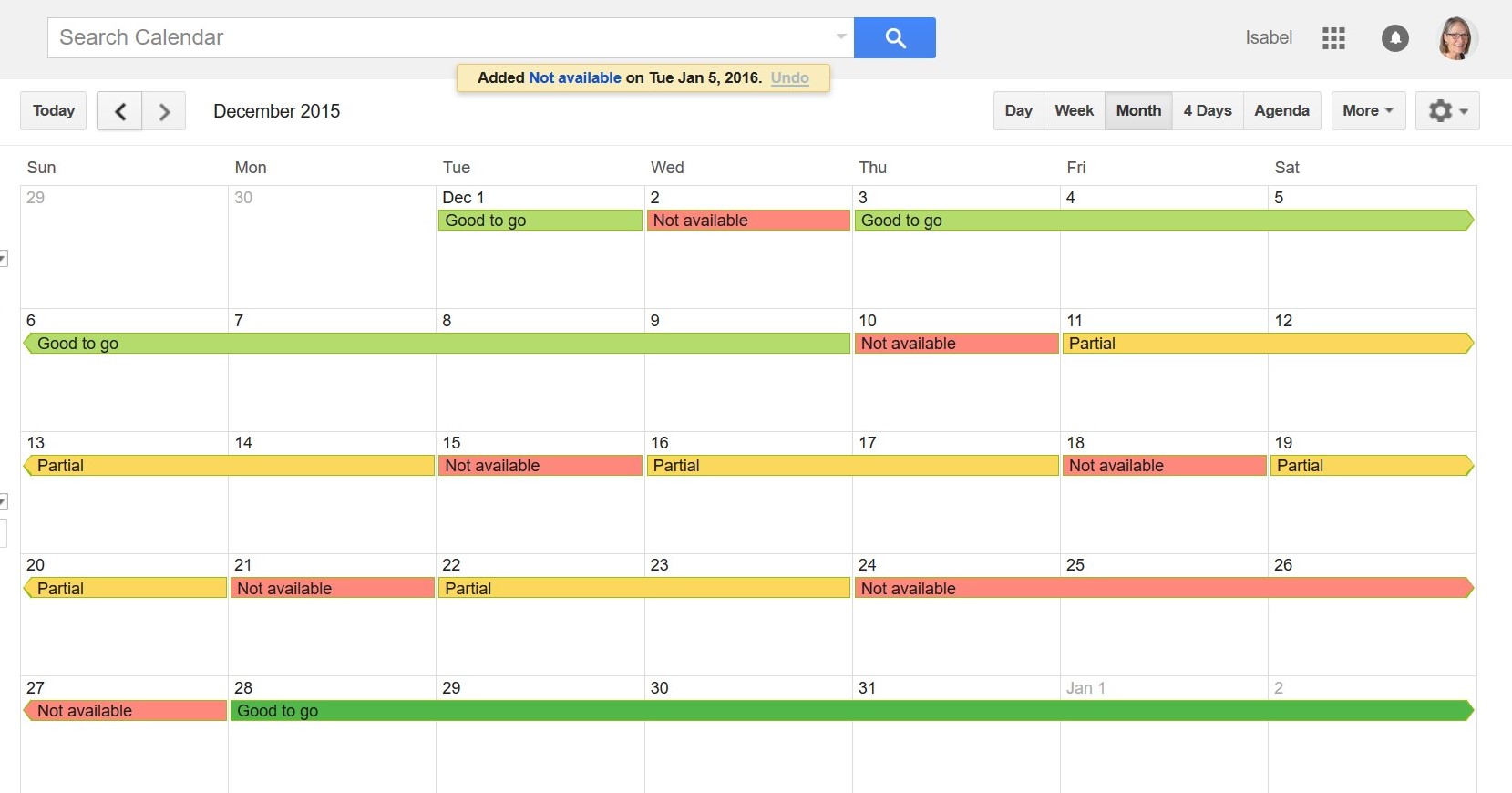
As the response schedule slides to the right, the project manager needs an update on my availability.

And so I start figuring it out.  It’s messy, but after a while I get it laid out clearly:

  • Good-to-go availability:  01 and 03 to 09 Dec; 28 Dec to 04 Jan
  • Part-day availability: 11 to 14 Dec; 16 and 17 Dec; 19 and 20 Dec; 22 and 23 Dec
  • Not available: 02, 10, 15, 18, 24 to 27 Dec

I’m pleased with my organization, but appalled at the thought of anyone actually trying to use this presentation to deconflict their schedule.

And so I try again.

Dec availability

Yes.  Much better.

In Proposal Land, as elsewhere, there is often a choice between telling and showing.  Showing is almost always better.


Term: Draft RFP

A preliminary version of the client’s RFP, usually issued to solicit industry feedback (for example, on the risk that industry is being asked to assume, the package of Work being requested, the standards being required, the pricing methodology) and to ask for alternative solutions that might otherwise be ruled non-compliant.

Often incomplete: most typical (and entirely deliberate) omission is the response instructions and evaluation criteria, since early release of those would give bidders a head start on the proposal.

Sometimes issued in a genuine effort to improve a procurement; sometimes appears to be issued as a pro forma response to an internal requirement to consult with industry.