
The period of time for which the contractor will provide the Work under the contract. Sometimes defined as a base period plus one or more option periods. Note that the choice to exercise said option is the client’s unilateral one.
How to Foster Teamwork: Rule #10
Bring the outside, inside.
Rhys Newman and Luke Johnson
How People get Disconnected from the Outdoors
Proposal team workspace tends to be temporary, no frills, cheap. In this speed-and-feed, cost-control-uber-alles environment, ergonomics gets little attention and any window is quickly plastered over with flipchart paper, the better to prevent industrial espionage.
With the long hours typical of proposals, people can go a long time without spending any appreciable time outside. I went into one proposal den in the depths of winter and didn’t come out until the summer. (That’s not literally true, of course — I trudged back to my hotel every night after dark, after all — but it’s true to my experience.)
The Consequences of this Disconnection
There’s just one thing. It’s not good for people.
It’s not good for their physical health, it’s not good for their mental health, and it’s not good for what we might call their professional health:
- Their productivity
- Their capacity for innovation
- Their ability to analyze and synthesize data and to see connections
- Their frequency of “Aha!” moments
- Their willingness to work with other people, overlooking their quirks
- Their ability to control their own quirkiness
The Remedy
What to do? It turns out this is one of the easier ones:
- Unblock a window.
- Meet when possible in an open area where people can at least see outside.
- Bring in flowers (or non-allergenic plants if pollen and scent are problems).
- Start a photo contest and post pictures of the world beyond your proposal room doors.
- Display colourful or interesting leaves and rocks that people bring in.
And where you have the option, actually get outdoors through the workday, too:
- Model a protocol of getting outside at lunch, every day, rain or shine, sleet or snow.
- Encourage walking meetings – outside.
Proposals are schedule-driven projects that require a strict project management discipline. Right? Partly right. In proposal terminology, I’d call that answer incomplete. Proposals are projects, for sure, but they’re also the output of teamwork. I’ve recently been learning how much the design business has in common with proposals.
This post is one of a series on proposal teamwork, inspired by a fabulous article on Medium on design teams:
“No Dickheads! A Guide to Building Happy, Healthy, and Creative Teams.”
Term: Data Item Description (DID)
A specification of each data deliverable required under the contract. Useful for saving time in determining content and format for reports and forms. Now largely archaic in Canadian government contracting, worse luck, but still extant in American contracting.
Acronymized as DID; DIDs in the collective/plural.
Related Links
How to Foster Teamwork: Rule #9
Hire a bookie.
(Betting on shit seems to be galvanizing and brings a team together.)
Rhys Newman and Luke Johnson
As someone who used to play poker with a cheat sheet — you know, this one . . .
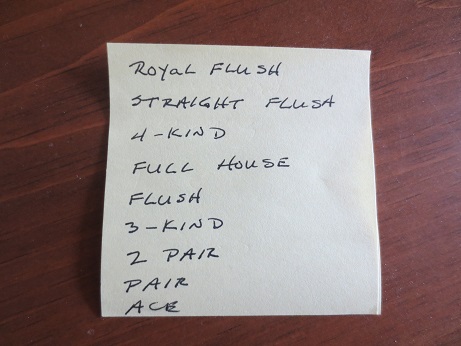
. . . I might be less than a credible source for this rule. But betting is akin, I think, to other silly games that proposal teams play, taking their fun where they can find it.
Betting: Analogous to Humour?
One form of humour is “something dangerous from a safe source” – just ask any 6-month old, giggling while being lofted into the air by a parent.
Maybe betting is analogous: something dangerous (competition) in a safe environment (insignificant amounts, unimportant outcomes).
How Does it Work?
By building trust? By fostering a sense of common purpose? Hey, what am I? A psychologist? Knowing why it works is less important than knowing that it does.
How to Execute?
So what would proposal teams bet on, in this day of Google access? Pretty much anything, as long as it isn’t look-uppable and doesn’t really matter.
Future sporting events (their outcomes, interim scores, number of goals/points)? Of course. The total lunch bill for a group, or the last number in it? Why not?
But proposal teams also have some task-related things they can bet on:
- The number of questions that the RFP will provoke
- The number of RFP amendments the client will issue
- Whether there will be an extension and how long it will be
Anything that transforms the activity into a game is worth considering.
Still Skeptical?
Not buying it? Maybe you’d like to lay a small wager. What odds are you prepared to give me that this doesn’t work for your proposal team?
Proposals are schedule-driven projects that require a strict project management discipline. Right? Partly right. In proposal terminology, I’d call that answer incomplete. Proposals are projects, for sure, but they’re also the output of teamwork. I’ve recently been learning how much the design business has in common with proposals.
This post is one of a series on proposal teamwork, inspired by a fabulous article on Medium on design teams:
“No Dickheads! A Guide to Building Happy, Healthy, and Creative Teams.”
Term: SDRL
Leaving aside marine uses of this acronym (Sea Date Required to Load), a SDRL is a Data/Document Requirements List for a Supplier, Subcontract, or Subcontractor. Pretty much all the same thing: data deliverables under a contract.
See also Contract Data Requirements List.